
Rain Agent Control Layer
Rain's Agent Control Layer is a policy layer over its card-issuing and money-movement APIs. A partner sets the rules for each agent before it can spend, and Rain enforces them when it decides whether to approve the transaction.
TL;DR
Rain’s Agent Control Layer is a policy layer over its existing card-issuing and money-movement APIs. A partner sets the rules for each agent before it can spend, and Rain enforces them when it decides whether to approve the transaction. It launched in beta on June 9, 2026.
- What it controls: card amount, merchant and category allowlists, spend intervals, and card expiry for each agent. It also caps active cards and total spend for the whole program. For bank and stablecoin transfers, it controls approved counterparties, amount, frequency and timing.
- How it enforces: rules are set “at card issuance and transfer initiation.” A transaction outside them “does not proceed.” That means an authorization decline, not a dispute after the fact.
- The main building block: a single-use virtual card for one task, funded from the user’s stablecoin balance, used once and then retired. Sponge (YC) runs on exactly this.
- Why Rain can do it: Rain is a Visa and Mastercard principal member and makes the approve/decline decision itself, so its rules run on the live authorization path.
- What’s missing: the public material doesn’t show task-bound credentials, human-in-the-loop approvals, agent identity (“Know Your Agent”) or dispute handling.
Rain’s developer docs require a login. Everything here comes from public posts, the press release and partner documentation. Mechanics I’ve inferred rather than found in a source are labelled inferred.
Where it sits in Rain’s stack
The Agent Control Layer sits between Rain’s API and its two engines: card authorization and money movement. Every agent card or transfer passes through it, so policy is always checked before money moves.
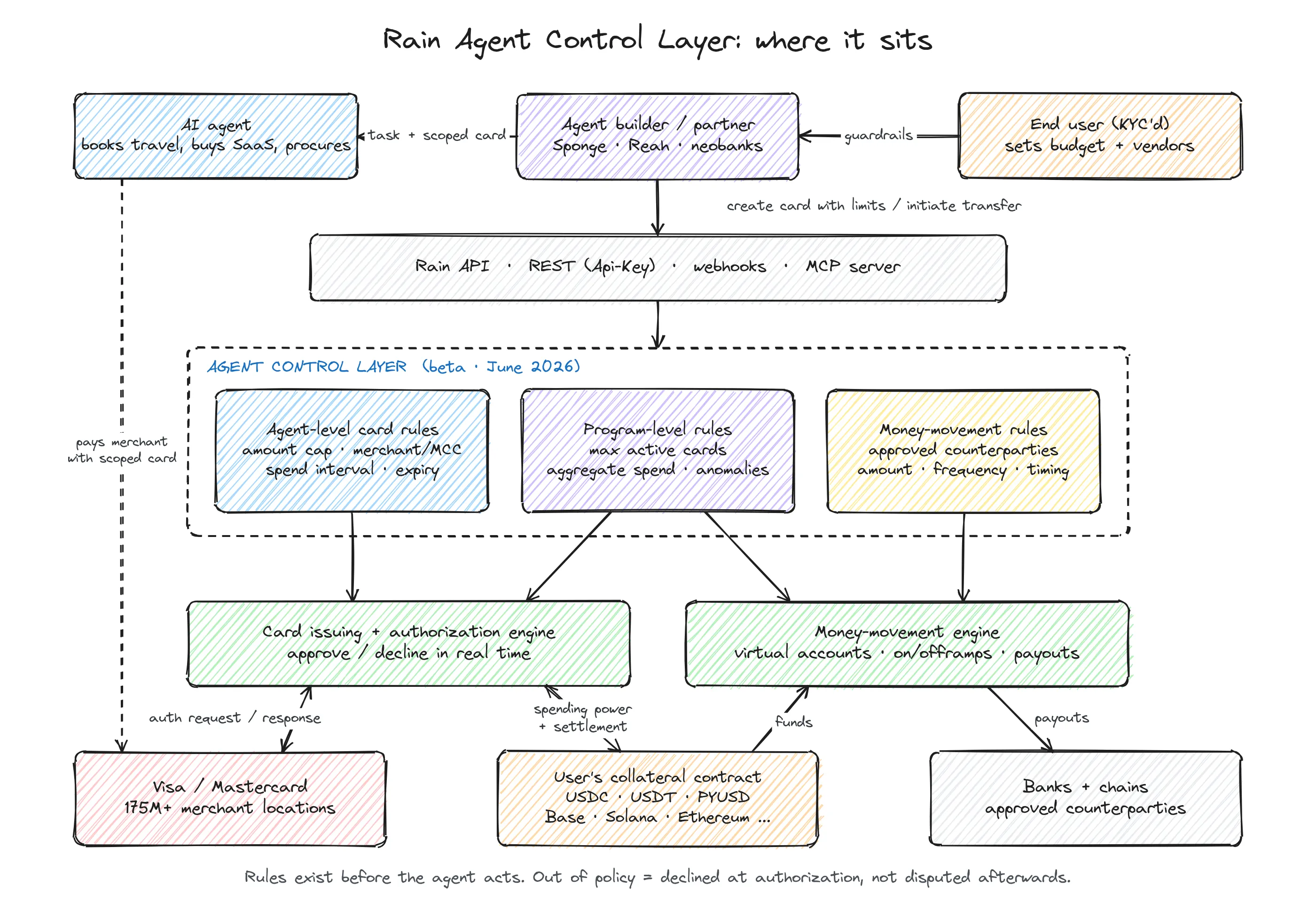
The agent never touches the user’s wider balance. It holds only a card number whose rules are enforced by Rain, which issues the card and decides whether to approve each payment. Collateral stays in the user’s own smart contract, and Rain settles against it after paying the merchant in fiat.
Control primitives
The controls fall into three groups: rules on each agent’s card, rules on the whole program, and rules on money movement. Rain’s own example: an agent given a card for a single booking “can be limited to approved airlines or hotels, capped at a set amount, and restricted to a defined window.”
| Group | Control | What it stops | Likely API surface |
|---|---|---|---|
| Agent card | Transaction amount cap | Overspend on a task | limit.amount on the card object (confirmed in partner docs) |
| Agent card | Spend interval | Repeated drains | limit.frequency (e.g. allTime, confirmed); other values inferred |
| Agent card | Merchant / category allowlist | Wrong vendor, wrong category | MCC and merchant lists checked at authorization (inferred) |
| Agent card | Card expiry window | A card outliving its task | Card expiry / status (active → cancelled) |
| Program | Cap on active cards | Runaway card creation by a buggy agent | Program config (inferred) |
| Program | Aggregate spend limit | Total loss across all agents | Program config, plus “visibility for unusual activity” |
| Money movement | Approved counterparties | Payouts to unknown wallets or accounts | Allowlist on virtual accounts, onramps, offramps, payments |
| Money movement | Amount, frequency, timing | Off-schedule or oversized transfers | Checked when a transfer is initiated |
The card controls sit on top of Rain’s existing card model. A user (KYC’d) owns a collateral smart contract funded with stablecoins. Rain issues a Visa card against it, with a limit of {frequency, amount}. A balances endpoint reports creditLimit, spendingPower and balanceDue in cents. The Agent Control Layer adds merchant scope, expiry and program-wide caps to that card, plus the same idea on transfers.
The unit of control is the card, not the agent. Each agent or task gets its own card, so revoking access means cancelling a card. Rain doesn’t publicly describe a separate agent identity object.
Transaction lifecycle
A purchase goes through ten steps. Policy is set at step 2, and Rain checks it at step 6 when the network asks it to approve or decline the payment.
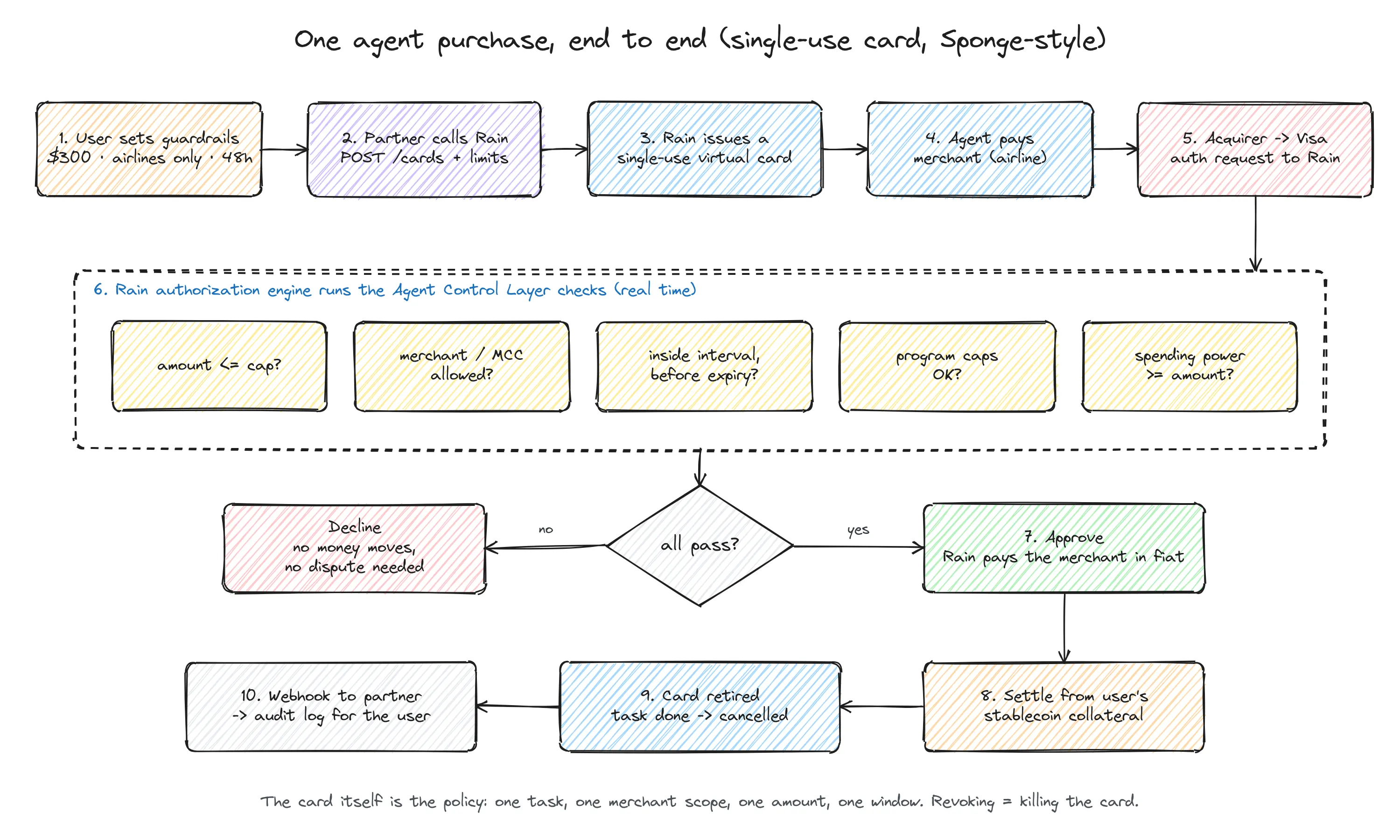
- Steps 1–3, setup: the user’s budget and vendor rules become a card. The policy lives in the
POST /cardspayload, and the card exists only for this task. - Steps 4–5, spend: the agent checks out like any customer. The merchant and acquirer see an ordinary Visa card.
- Step 6, enforcement: Rain compares the payment against the card’s rules, the program caps and the user’s available collateral (
spendingPower). Exactly which checks run in real time is inferred from the controls Rain publishes. - Steps 7–10, close out: Rain pays the merchant in fiat and settles from the collateral contract. The card is retired, and the partner gets a webhook it can use for an audit trail.
Transfers follow the same pattern without a card network: the counterparty, amount, frequency and timing are checked when the transfer is initiated.
Developer integration
Rain integrates through a REST API that authenticates with an Api-Key header. A Crossmint wallet guide shows the endpoints for a stablecoin-backed card (staging base api-dev.raincards.xyz/v1):
POST /issuing/applications/usercreates the user application with KYC data. The response returns auserIdand anapplicationStatus.POST /issuing/users/{userId}/contractsdeploys the collateral contract on a chosenchainIdand returns adepositAddress.- The user funds that address with stablecoins (USDC, USDT, PYUSD and others, on Ethereum, Base, Polygon, Solana, Avalanche and more).
POST /issuing/users/{userId}/cardsissues the virtual card withtype,limit {frequency, amount},displayNameandstatus. For an agent, this is the call that carries the policy.GET /issuing/users/{userId}/balancesreadsspendingPowerbefore the agent acts.
Rain publishes an AsyncAPI definition for its webhooks and has an MCP server. Even so, API Evangelist scores its developer ergonomics at 2.9/20 because so little of the docs is public or machine-readable. The public docs don’t cover idempotency, error semantics, sandbox simulation, SDKs, or reference agents.
Inferred: the Agent Control Layer probably extends the card-create payload (merchant/MCC lists, expiry) and adds a program-level config object, rather than introducing a new resource. I couldn’t confirm this because the docs need a login.
Customers and ecosystem
Two customers are public, and they use the layer in different ways: one for single-use cards, one as an operating system for agents across several payment types.
| Who | What they build | How they use Rain | Quote |
|---|---|---|---|
| Sponge (YC) | Agents that buy software, compute, travel and data for users | User completes KYC and the agent acts as an extension of the user. Each purchase gets a single-use virtual card against the user’s stablecoin balance, retired afterwards | “The easiest way to set up a card issuance program, especially one backed by stablecoins” (Eric Zhang, co-founder) |
| Reah | Agentic finance OS | One policy engine across card, account and stablecoin payments, with live balance checks and full audit logs | “Money can move programmatically across rails, with clear guardrails, all in one place” (Jake Margulies, co-founder) |
On August 18, 2026 Rain launched the Agentic Payments Alliance with 25 founding members, including Visa, Mastercard, Fiserv, Circle, Solana, Avalanche, Monad, Uniswap Labs, Fireblocks, Turnkey, Crossmint, Lithic and Sardine. Its working groups cover agent identity and authorization standards, regulation, and an Agentic Startup Program. CEO Farooq Malik: “No single company should get to decide how agents transact on someone’s behalf.”
Gaps and what to build next
Today’s beta controls what an agent can spend. It doesn’t yet cover who the agent is, when a human has to approve, or what happens when a payment is disputed.
Sources
- Introducing the Agent Control Layer (Rain)
- Press release, June 9, 2026 (PR Newswire)
- Sponge is betting on agentic commerce (Rain)
- Q&A: how Reah is building safer agentic commerce on Rain (Rain)
- Rain launches the Agentic Payments Alliance (Rain)
- Crossmint guide: Rain card issuance API (endpoints and fields)
- Sacra: Rain (collateral model)
- API Evangelist: Rain (DX score, webhooks, MCP)